Free Shipping on 100$+
Your Plastic Toothbrush Is Delivering the Same Plastic Found Accumulating in Alzheimer's Brains
Your brain is now 0.5% plastic by weight. Dementia brains contain 10x more. The dominant polymer? Polyethylene, the same plastic in your toothbrush bristles. PRIMALS Boar Bristle Toothbrush is 100% plastic-free. Zero microplastics reaching your brain.
 Stop Feeding Plastic to Your Brain
✓ Free Shipping on $100+ ✓ 100% Plastic-Free ✓ 100K+ Switched
Human Brain Tissue Now Contains 0.5% Plastic by Weight. Up 50% in 8 Years.

A 2024 Nature Medicine study found brain microplastic levels increased 50% in just 8 years. The brain contained 7 to 30x more plastic than the liver or kidney.
The dominant polymer? Polyethylene, the same plastic in your toothbrush bristles. Once in the brain, your body has no mechanism to remove it.
Dementia Brains Contain Up to 10x More Plastic. Researchers Found Microplastics in Alzheimer's Cerebrospinal Fluid.

UNM neuropathologist Dr. Elaine Bearer found dementia brains contained up to 10x more microplastic than healthy brains. The amount correlated directly with the severity of dementia.
A separate 2025 study detected microplastics in the cerebrospinal fluid of Alzheimer's patients for the first time. Those with Alzheimer's pathology had significantly elevated polyethylene and PVC compared to healthy subjects.
Microplastics Act as a "Catalytic Scaffold" for Amyloid Plaque, the Hallmark of Alzheimer's

A 2025 study found microplastic surfaces act as a "catalytic scaffold" for amyloid plaque, the protein buildup that drives Alzheimer's. The damage starts at sub-lethal doses, long before any symptoms appear.
Microplastics trigger Alzheimer's pathways at sub-lethal doses. The damage starts decades before symptoms. The only intervention is to stop the source.
Stop Feeding Plastic to Your BrainFree shipping on $100+ • 100% plastic-free
If You Carry the APOE4 Gene, Microplastic Exposure Triggers Alzheimer's Symptoms Faster

Mice carrying the APOE4 gene were exposed to microplastics for just 3 weeks. The result: memory loss and apathy, directly matching human Alzheimer's patterns (University of Rhode Island, 2025).
25% of people carry APOE4. If you have a family history of Alzheimer's, reducing microplastic exposure is the single most controllable environmental factor available.
3,000+ Microplastic Particles Every Use. Absorbed Through Gums 10x Faster Than Skin. Delivered Straight to Your Brain.

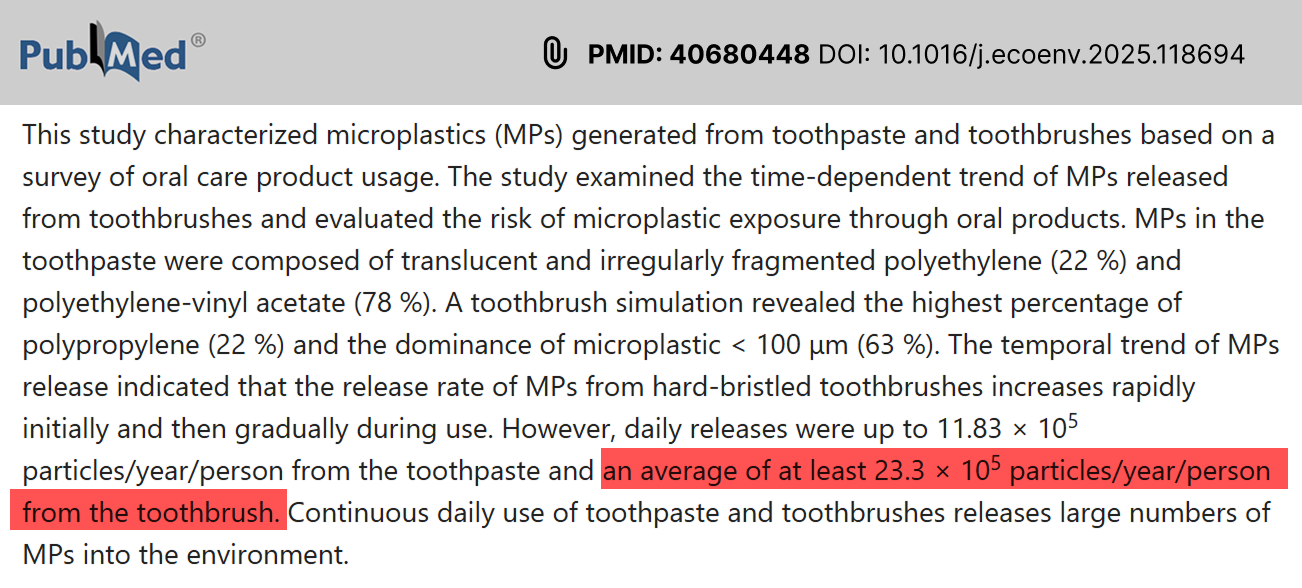
Plastic toothbrushes release 3,000+ microplastic particles per use. 63% pass directly through gum tissue into your bloodstream. Your gums absorb 10x faster than skin.
The pathway is direct: gum tissue to blood to brain. Twice a day, you press plastic against the most absorptive tissue in your body and deliver the same polymer found in Alzheimer's brains.
Independent Clinician Evaluations
Clinicians receive product samples and are never compensated to submit evaluations.

I love the Boar Bristle & Bamboo Toothbrush because the bristles are composed entirely of animal fibers. That means they are made without plastic like many toothbrushes you would find at the store. Research in Environmental Pollution found that standard plastic toothbrushes can and often do shed microscopic particles or "microplastics." Over years of brushing, those microplastics can quickly accumulate, so I encourage patients to explore plastic-free alternatives like this one from PRIMALS. It's great that the boar bristles can be effective for cleaning the teeth and protecting the enamel as well. There is a lot that I like about this product, and I would happily recommend it as part of an oral care routine.

I highly recommend the PRIMALS toothbrush to patients whose gums may be irritated by stiff nylon bristles. A review of research found that hard-bristle toothbrushes can cause more gum abrasions than softer options, suggesting that soft and extra-soft brushes tend to be safer choices for most people. I expect many patients may notice that the boar bristles on this toothbrush feel noticeably softer and more flexible than standard nylon. This can offer a gentler brushing experience for sensitive gums. I appreciate the boar bristles are woven directly into the head, avoiding the use of glue or adhesives that may become triggers of irritation. After reading the research, I feel good about this product as a comfortable, low-chemical option for everyday brushing.
The Only Toothbrush That's 100% Plastic-Free
Handle and bristle. Every component. Nothing synthetic reaching your brain.

Selling fast ✓ Free Shipping on $100+
Real People. Real Results.


⚠️ Brain microplastic concentration has increased 50% in 8 years. It is accelerating.
You Cannot Undo the Decades Already Accumulated. But You Can Stop Adding More Today.
You take supplements. You exercise. You eat well. But twice a day, your toothbrush delivers the same polyethylene now found concentrated in Alzheimer's brain tissue. One swap. 2.3 million fewer particles per year. The fix takes 30 seconds.
Stop Feeding Plastic to Your BrainQuestions & Answers
Dementia brains contain up to 10x more microplastic than healthy brains, correlating with the degree and type of dementia (UNM, 2025). Microplastics were detected in the cerebrospinal fluid of Alzheimer's patients for the first time, with polyethylene and PVC elevated in amyloid-positive subjects (Journal of Hazardous Materials, 2025). In mice carrying the APOE4 Alzheimer's risk gene, just 3 weeks of microplastic exposure triggered memory loss and apathy matching human Alzheimer's patterns (University of Rhode Island, 2025). Researchers have identified five distinct mechanisms by which microplastics promote neurodegeneration, including acting as a "catalytic scaffold" for amyloid plaque formation (BioRxiv, 2025; UTS, 2026).
Plastic toothbrushes shed 3,000+ microplastic particles per use. 63% are smaller than 100 micrometers. Your gum tissue absorbs compounds 10x faster than skin. Once absorbed, microplastics enter the bloodstream, cross the blood-brain barrier, and accumulate in brain tissue, particularly in the myelin sheath around neurons. The dominant polymer found in brain tissue is polyethylene, the same plastic in toothbrush bristles. (PMID: 40680448; Nature Medicine, 2024)
APOE4 is the largest known genetic risk factor for Alzheimer's disease. Approximately 25% of the population carries at least one copy. A 2025 URI study found that mice carrying APOE4 developed Alzheimer's-like symptoms after just 3 weeks of microplastic exposure. If you have a family history of Alzheimer's or dementia, reducing microplastic exposure is one of the most controllable environmental factors available to you.
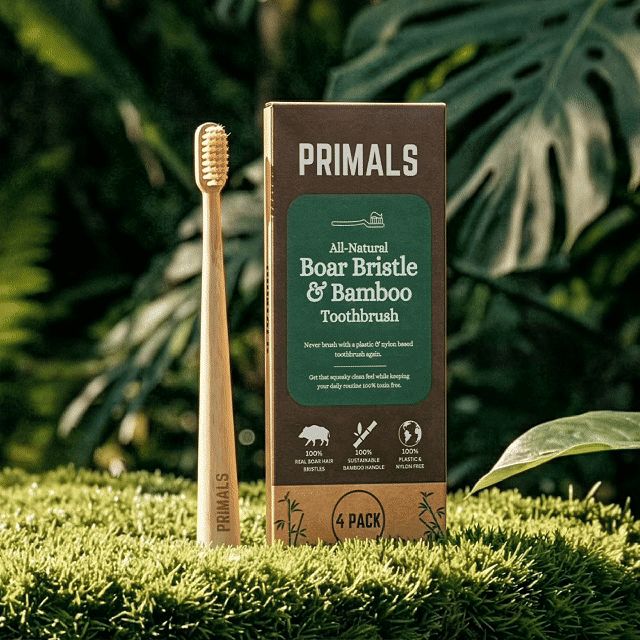
100% natural boar hair bristles and a sustainable bamboo handle. No plastic, no nylon, no synthetic materials of any kind. The bristles are mechanically woven into the brush head without synthetic glue. Boar bristles are natural keratin, the same protein as hair and nails. They deliver zero polyethylene, zero microplastics, and zero synthetic particles.
Yes. Boar bristles are naturally tapered and have a texture that grips and removes plaque effectively. Most users report a "squeaky clean" polished feeling. They deliver a thorough deep clean without shedding synthetic particles into your body.
2-3 months per brush. One 4-pack covers you for a full year. Unlike plastic bristles that shed more microplastics as they wear, boar bristles maintain effectiveness throughout their lifespan without fragmenting.
Currently, there is no known mechanism for the human body to break down or remove microplastics from brain tissue. Once they accumulate, they stay. This is why researchers emphasize reducing exposure as the primary intervention. Stopping the source is the only step available.
Protect Your Whole Body.
Every product touching your body matters.

Learn More
Research-backed guides for PRIMALS products.
[1] Nihart AJ et al. (2024). Bioaccumulation of microplastics in decedent human brains. Nature Medicine. DOI: 10.1038/s41591-024-03453-1
[2] University of New Mexico (2025). Researchers find alarmingly high levels of microplastics in human brains. UNM HSC Newsroom.
[3] Bearer E. (2025). Hidden brain damage behind dementia. ScienceDaily, Oct 2025.
[4] Wang H et al. (2025). Association of microplastics in human cerebrospinal fluid with Alzheimer's disease-related changes. Journal of Hazardous Materials.
[5] Ross J et al. (2025). URI study links microplastic exposure to Alzheimer's disease in mice. University of Rhode Island.
[6] Neves da Silva I et al. (2025). Microplastic Exposure Promotes Amyloid Misfolding and Metabolic Impairment. BioRxiv.
[7] Wang G et al. (2024). Exposure to polystyrene microplastics promotes cognitive impairment in Alzheimer's disease. Molecular Neurobiology. PMID: 37670159
[8] Gecegelen E et al. (2025). A novel risk factor for dementia: chronic microplastic exposure. Frontiers in Neurology.
[9] Siu ACW et al. (2026). Do microplastics play a role in neurodegenerative diseases? Molecular and Cellular Biochemistry.
[10] Ecotoxicology and Environmental Safety (2025). Microplastic release from toothbrushes. PMID: 40680448