Leading plastic vs leading castor oil vs PRIMALS.
See which one won.
We tested all three electric toothbrushes for plastic, mold and EMF. 2.3 million microplastics a year. 265 V/m at your jaw against 14. Mold in a cavity you cannot reach.

a lens
replacement cycle
field meter
Two of these three brushes are made of plastic
And the bristle is the only part that touches you. Three tabs: how much comes off, where it goes, and what it does once it gets there.

Around 3,000 particles every session, roughly 2.3 million a year, and a sonic motor grinds them loose faster than a manual brush does. Plant-based nylon sheds the same way petroleum nylon does. The source changed, the material did not.
Where the particle numbers come from
Ecotoxicology and Environmental Safety, 2025 (PMID 40680448), which measured roughly 3,000 microplastic particles released per brushing session. The annual figure is arithmetic from that at two sessions a day. The study examined manual brushes; a fast motor puts more stress on the bristle, not less.

This is the part people miss. It is not that plastic ends up in your mouth. It is that your mouth is the doorway. Swallowing it would be better; your gut passes most of it. Gum tissue does not.

What this study does and does not show
New England Journal of Medicine, 2024. Researchers examined carotid plaque removed from patients during surgery and followed them for around 34 months. Those with polyethylene or PVC detected in the plaque had a 4.5x higher rate of heart attack, stroke or death from any cause, and their plaque showed raised inflammatory markers. An association was observed. The study does not establish that microplastics caused those events, and it did not study toothbrushes.
Ninety days, side by side
One replacement cycle. Scrub the timeline and watch what happens to each bristle, and to the head it sits in.


Every electric brush runs a motor beside your head
Nobody publishes what it gives off. So we put all three on the same meter. Two tabs: what we measured, and what it means for you.

Nobody else publishes this number. Not because it is flattering or unflattering, but because nobody asks. We measured all three on the same meter and printed what came back.
How we measured it
All three brushes on the same ERICKHILL RT-100 meter, same distance, same mode, highest intensity setting, averaged across more than 100 readings. Magnetic field read 88.29 microtesla for the leading sonic brush against 17.62 for PRIMALS, about 5x less. Individual readings vary with meter, distance, mode and intensity.

What EMF actually means here. Any motor running on electricity creates an electromagnetic field around it. A meter measures how strong that field is in volts per meter, written V/m. Bigger number, stronger field.
Every other source in your house you can simply step away from. The whole design of this one is that you hold it there.
We are not telling you this harms you. No health effect has been established, and anyone who tells you otherwise is ahead of the evidence. What we did was measure ours, publish the number, and engineer it down to 14 V/m. If the review closes badly, you were never in the exposure. If it closes well, you gave up nothing.
Sources for these findings
Induced current findings: PMID 23037851 and PMID 24240898, which measured the fields produced by five electric toothbrushes and the currents they induced in intraoral metal. Group 2B is the International Agency for Research on Cancer classification applied to low-frequency magnetic fields, based on studies of residential and occupational exposure rather than personal care devices. WHO Environmental Health Criteria 238 (2007) and later reviews. Research is ongoing. Beyond the induced current findings above, no health effect has been established and we make no further health claims about electromagnetic fields on this page.
Three parts, one winner
A narrow test, and lopsided because it is narrow. On price, design and availability the answers go the other way.
Starting from a plant and using a recyclable head are better for the planet. Neither changes what ends up in your body while you brush.
Three parts tested. PRIMALS wins all three.

Clinicians who have shared PRIMALS
Verified clinicians who have looked at the research behind PRIMALS bristles and shared it in their own words.
“I love the Boar Bristle & Bamboo Toothbrush because the bristles are composed entirely of animal fibers. That means they are made without plastic like many toothbrushes you would find at the store. Research in Environmental Pollution found that standard plastic toothbrushes can and often do shed microscopic particles or ‘microplastics.’ There is a lot that I like about this product, and I would happily recommend it as part of an oral care routine.”
 Dr. Preeti Kallu, MDInternal Medicine · 26 years in practice
“I like this as an alternative to regular toothbrushes, some of which may expose patients to chemicals called endocrine disruptors. Found in nylon and plastic, these chemicals may mimic the body's own hormones and may send false signals to cells with potentially damaging downstream effects. Since we brush our teeth every day, the mouth can become a recurring entry point for these chemicals. That’s why I am such a fan of the Boar Bristle Toothbrush. It uses natural boar hair bristles and a bamboo handle that is designed without synthetic polymers like plastic. For plastic-conscious patients, switching to an all-natural toothbrush like this one may reduce exposure to certain chemicals and help maintain a safe dental routine.”
 Cretude Dorcius, NPPrimary Care · 4 years in practice
“Conventional nylon bristles can shed tiny plastic fragments with every use. This bamboo toothbrush from PRIMALS uses natural horse hair bristles instead, which may appeal to patients wanting to reduce their exposure to microplastics. Horse hair is made of keratin, the same protein found in human hair and nails. As part of a more plastic-conscious lifestyle, I think switching to a toothbrush like this one from PRIMALS is an easy choice to make.”
 Dr. Matthew Finnegan, MDPrimary Care · 38 years in practice
“I think anyone looking to preserve the integrity of their teeth should try this PRIMALS bamboo toothbrush. I like that the horsehair bristles of this toothbrush are naturally fine and flexible, so gentleness is built into the material rather than engineered through different grades of nylon. The bristles are also anchored without glue or synthetic binders, which tells me there are fewer potential irritants to contact sensitive gum tissue.”
 Arpita Patel, NPFamily Medicine · 7 years in practice
Shared via FrontrowMD. Clinicians are compensated for their time reviewing product materials and research. Statements reflect individual professional opinion, not medical advice.
What it looks like in use
Both brushes, photographed in ordinary homes rather than a studio.


Which bristle do you prefer?
Same handle, same low-EMF motor, same 62,000 vibrations per minute. Only the bristle changes, and both heads fit the same handle.
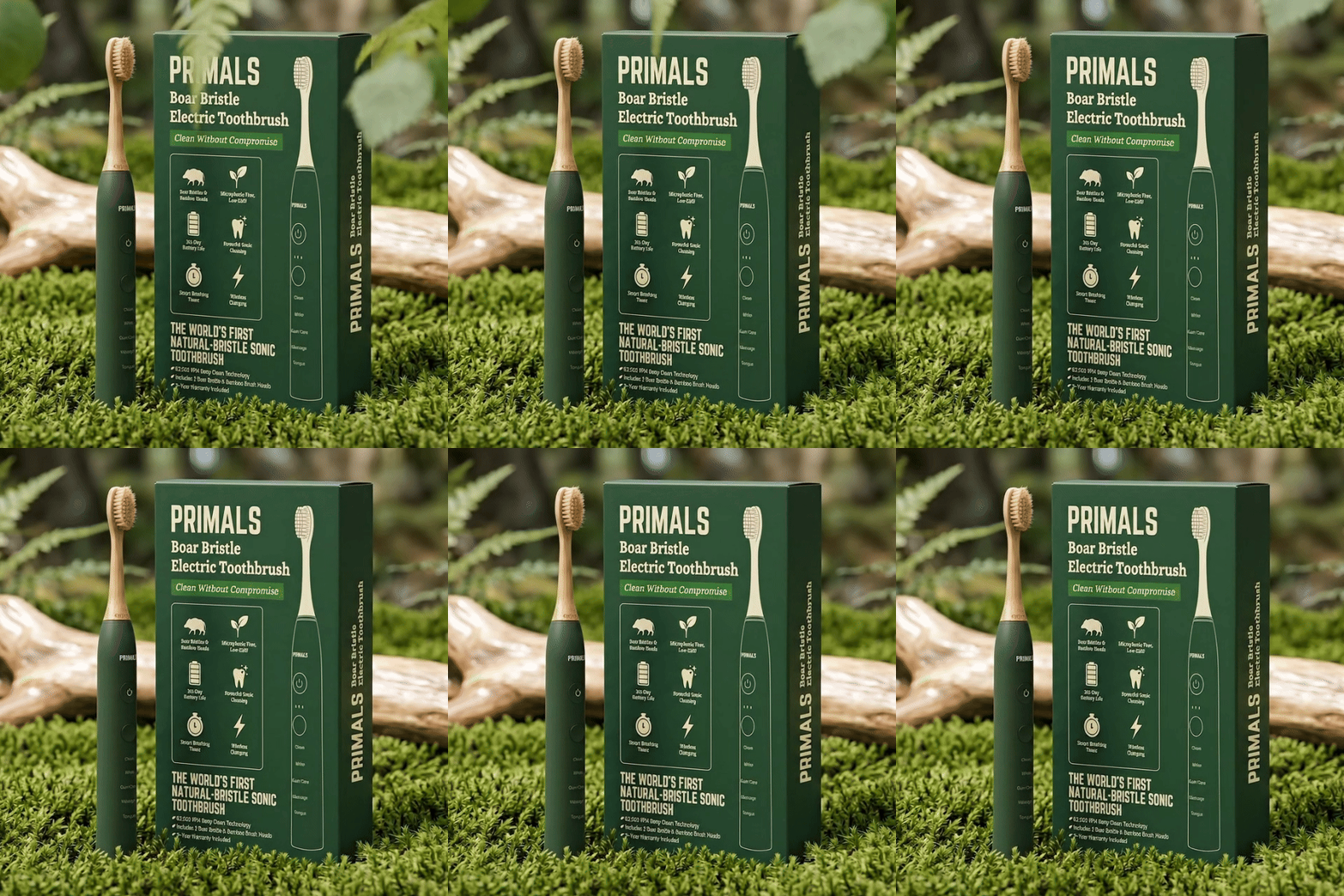
PRIMALS Boar Bristle Electric Toothbrush
If you prefer firm bristlesFirm natural bristle that digs into plaque and buildup for a proper scrub.
Best for: deep cleaning, plaque and stain buildup
Shop Boar Bristle
PRIMALS Horse Bristle Electric Toothbrush
If you prefer soft bristlesThe softest natural bristle. Flexes along the gumline instead of scraping at it.
Best for: sensitive gums, receding gumlines, kids 6+
Shop Horse BristleBoth include 2 replacement heads · 2-year warranty · 60-day satisfaction guarantee
Questions this raises
No. It is published by PRIMALS. Every figure here comes from a brand's published specifications or from a test we ran and described, and the method for each one is written out on the page so you can check it.
All three brushes were run on the same ERICKHILL RT-100 field meter, at the same distance, in the same mode, at the highest intensity setting, with figures averaged across more than 100 readings. The leading plastic brush read 265 V/m, the castor oil bristle brush 100 V/m and PRIMALS 14 V/m. Individual readings vary with meter, distance, mode and intensity.
They are matched macro frames of each bristle type, same magnification, same time points. Particle totals are calculated from the published per-session figure rather than measured on our own samples, as the source note says.
The opposite in practice. Boar and horse bristle are naturally antimicrobial, and heat-treated bamboo dries between brushes instead of trapping moisture. Replace every 1 to 3 months, the same as any head.
60-day satisfaction guarantee, a 2-year warranty on the brush, and real humans on email support seven days a week.

